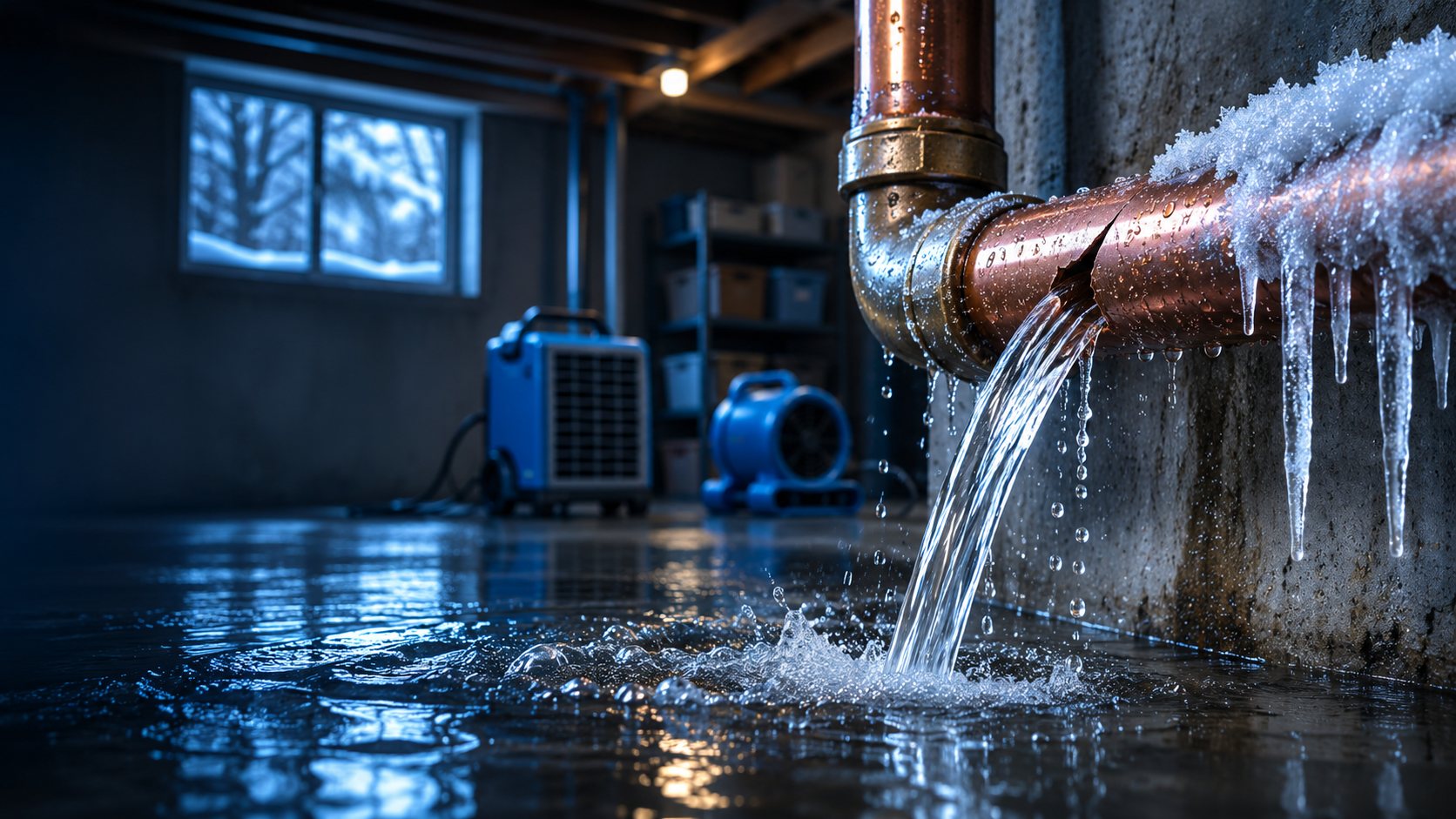
Burst Pipe Repair in Suffolk County, NY
Alfa Restorations is based at 66 Cain Dr in Hauppauge, in the middle of Suffolk County, which makes most of western and central Suffolk a 30-minute response. A burst pipe can release several hundred gallons an hour, so the water needs to be off and the extraction started the same day. IICRC-certified crews, documented structural drying, insurance billed directly.
Why Suffolk pipes burst
Suffolk is bigger, more spread out and more seasonal than Nassau, and each of those things puts more pipe in the cold.
Larger lots, longer service runs. Bigger lots mean the water service travels further from the street to the house. That is simply more pipe exposed to frozen ground and unheated space before it reaches the warm part of the building.
Crawlspaces instead of basements. Across much of central Brookhaven, houses were built over crawlspaces rather than full basements. That puts the supply lines in genuinely unheated space, a few feet above bare ground, where they sit at or near outdoor temperature on a cold night.
Private wells. Many Suffolk homes are on private wells, with a pressure tank and above-ground plumbing in a utility room that was never designed to be heated. When that room freezes, the tank, the fittings and the exposed piping all go at once.
The oldest North Shore villages. Historic village housing still has original plumbing routed through exterior walls with no insulation behind it, because none was used when these houses were built. Some of it is galvanized steel, which corrodes from the inside, narrows, and then splits rather than pinholes.
The cold nights that cause it
Pipes do not burst at 32 degrees. They burst when an uninsulated run sits well below freezing for long enough for the water inside to freeze, expand and split the pipe, and then flood when it thaws.
In Suffolk that generally means an overnight low in the teens or lower, held for several hours, usually with wind. Houses exposed to the Sound and the ocean are worse than the thermometer suggests, because sustained wind across exposed north and west elevations pulls heat out of wall cavities far faster than still air.
The second pattern is the thaw. A great many bursts are not discovered during the cold snap but on the afternoon it breaks, when the ice plug melts and the split starts releasing water. If you lost water pressure during a freeze and it came back, check for leaks before assuming it was fine.
The East End problem: a burst nobody finds
A large share of homes from Westhampton east are seasonal or second homes, closed up from autumn to spring. A pipe that bursts in February in an empty Bridgehampton or Montauk house is found in April.
By then it is not a burst pipe job. Two months of water has soaked framing, subfloor, insulation and ceilings, mold has colonized everything porous, and the scope is a gut and rebuild rather than a dry-out. These are the largest residential losses we handle anywhere on Long Island, and almost all of them would have been routine if they had been found in week one.
The insurance position is worse too. Most policies require heat to be maintained, and many reduce or exclude coverage once a property has been vacant for 30 or 60 days. A frozen pipe in an unheated vacant house is the clearest denial there is.
If you own a seasonal property out here, two things are worth more than anything else on this page: shut the water off at the main and drain the system when you close up, and fit a monitored low-temperature and water sensor. Both cost a fraction of one claim, and a claim may not be paid.
Where we see them, by area
The North Shore (Huntington, Northport, Centerport, Cold Spring Harbor, Smithtown, Stony Brook): older village housing with original plumbing in uninsulated exterior walls, plaster and old-growth hardwood that need Class 4 specialty drying, and newer hillside houses with supply lines run through unheated attics.
Central Suffolk and Brookhaven (Commack, Hauppauge, Ronkonkoma, Centereach, Selden, Coram, Medford): crawlspace construction, garage runs and longer service lines. Mostly single-pipe failures in predictable places, and closest to our Hauppauge base.
Further east: larger lots, private wells with pressure tanks and above-ground plumbing in unheated utility rooms.
The East End (Westhampton, Southampton, Bridgehampton, East Hampton, Montauk and the North Fork): seasonal homes closed up for the winter, where the burst itself is ordinary and the weeks before anyone finds it are what make it expensive.
Towns we cover in Suffolk County
Amagansett · Amityville · Aquebogue · Babylon · Bay Shore · Bayport · Bellport · Brentwood · Bridgehampton · Calverton · Center Moriches · Centereach · Centerport · Central Islip · Cold Spring Harbor · Commack · Copiague · Coram · Cutchogue · Deer Park · Dix Hills · East Hampton · East Islip · East Northport · Farmingville · Fort Salonga · Greenlawn · Greenport · Hampton Bays · Hauppauge · Holbrook · Holtsville · Huntington · Islandia · Islip · Jamesport · Kings Park · Lake Grove · Lake Ronkonkoma · Lindenhurst · Lloyd Harbor · Manorville · Mastic · Mattituck · Medford · Miller Place · Montauk · Mount Sinai · Nesconset · North Babylon · Northport · Oakdale · Patchogue · Port Jefferson · Riverhead · Rocky Point · Ronkonkoma · Sag Harbor · Sayville · Selden · Shelter Island · Shirley · Shoreham · Smithtown · Southampton · Southold · St James · Stony Brook · Wading River · West Babylon · West Islip · Westhampton
Dedicated burst pipe pages for Suffolk County:
What we do
- Emergency response and water shut-off, 24/7
- Water extraction and structural drying with documented daily readings
- Specialty drying for hardwood, plaster and slab
- Ceiling and multi-floor water damage from an upstairs burst
- Mold prevention and remediation
- Contents pack-out and storage
- Reconstruction: drywall, flooring, trim, paint
- Insurance documentation and direct billing
Note: we handle the water damage, the drying and the rebuild. The pipe repair itself is a plumber's job, and we will coordinate with yours or recommend one.
How to stop it happening again
The fixes are cheap relative to a claim:
- Insulate the exposed runs. Garage, crawlspace, attic and exterior-wall sections. Pipe sleeve is inexpensive and takes an afternoon.
- Keep the heat on and the thermostat no lower than 55 degrees, including when away. Most policies require it, and it is the single most common reason a burst pipe claim gets denied.
- Insulate or heat the well and pressure tank room if you are on a private well. It is the most exposed plumbing in the house.
- Open cabinet doors under sinks on exterior walls during a cold snap so room air reaches the pipes.
- Let a tap drip on the most exposed run on the coldest nights. Moving water is much harder to freeze.
- Know where your main shut-off is and check that it actually turns. A seized valve turns a ten-minute problem into a two-hour one.
- If the house will be empty, shut the water off at the main and drain the system, or have someone check it. Add a low-temperature alarm or a water sensor if it is unoccupied for long stretches.
Water in the House? We're Ready 24/7.
30-minute average response across Nassau and Suffolk County.
(516) 306-7749