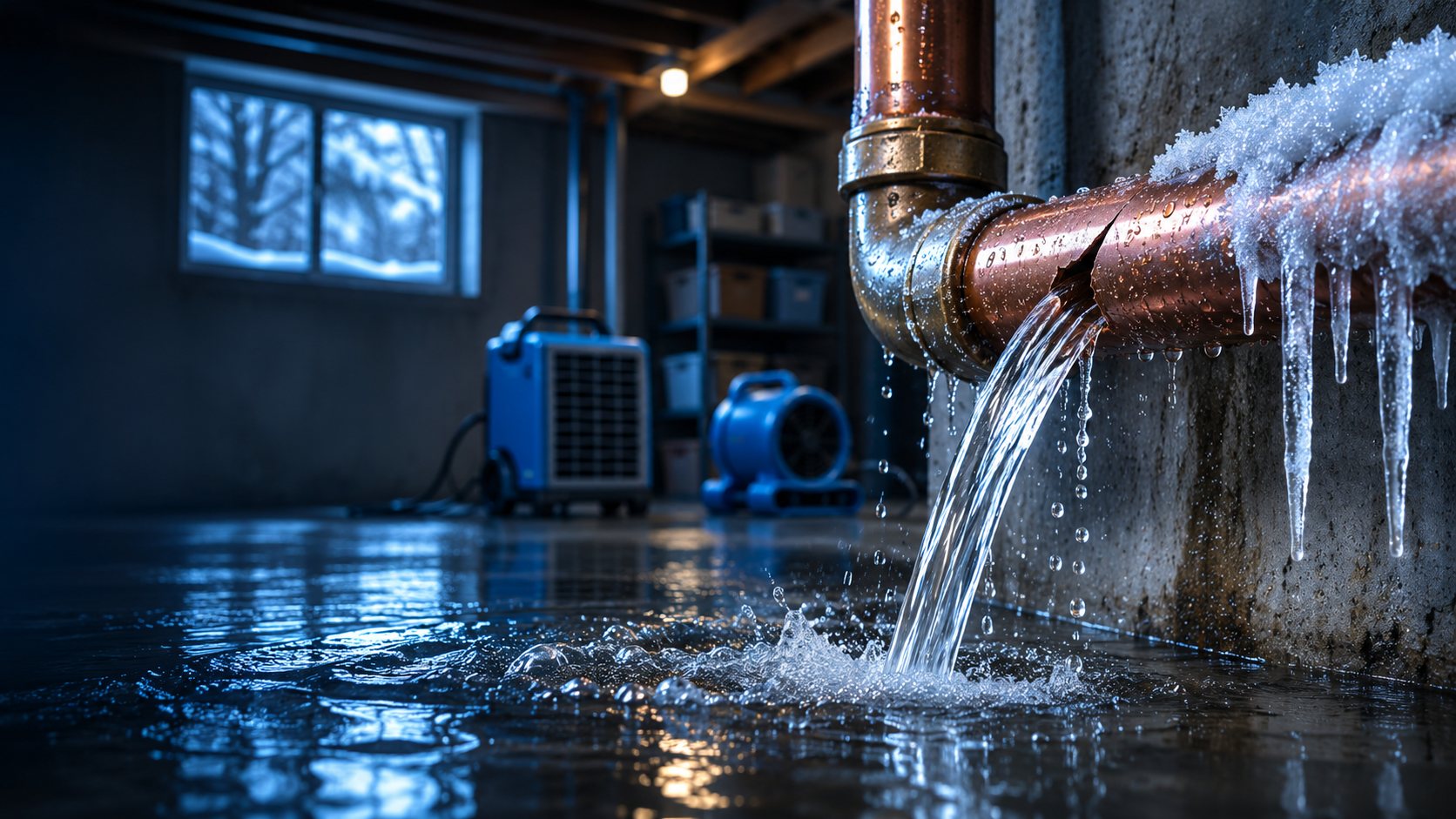
Burst Pipe Repair in Stony Brook, NY
A burst pipe can release several hundred gallons an hour, so the water needs to be off and the extraction started the same day. Mold begins colonizing wet drywall and framing after about 24 hours. Alfa Restorations reaches Stony Brook in about 30 minutes, 24 hours a day. Call (516) 306-7749.
Why pipes burst in Stony Brook
Stony Brook sits around the Mill Pond and the harbour, with the historic village at the bottom of the drainage. Cold air settles in that low ground overnight and the village core runs colder than the higher land around it, which is where the marginal nights turn into burst pipes.
The historic housing is the most demanding work on this site. Eighteenth and nineteenth century houses with original timber, plaster and shallow cellars cannot be dried the way a modern house is dried. Aggressive equipment causes cracking and shrinkage in material that cannot be replaced, so these properties get lower-intensity drying over a longer period, with readings taken from inside the structure rather than off the surface.
Stony Brook has one problem its neighbours do not, and it is the single most expensive one here. The university rental stock means a large number of houses with absentee landlords and tenants away over the winter break. A burst in an empty student house in late December can run for days or weeks before anybody reports it, and what would have been a straightforward extraction becomes a reconstruction. If you let property here, shut the water off at the main between tenancies and over the break. It costs nothing and it is the difference between a small job and a very large one.
Newer development on the higher ground follows the ordinary pattern of attic and garage runs.
What to do before we arrive
- Shut the water off at the main. It is usually in the basement or crawlspace on the street-facing wall, or in a box near the kerb. Turn it clockwise until it stops.
- Shut off power to the affected area at the panel, if you can reach it without standing in water. If you cannot, leave it and stay out.
- Open a downstairs tap to drain the remaining water in the system rather than leaving it in the pipes.
- If the burst is on a heating line, shut the boiler down too.
- Photograph everything before you move anything. This is what the claim is built on.
- Move what you can lift off the wet floor.
- Do not cut into drywall or ceilings before the inspection.
How we handle a burst pipe
- Dispatch, 30 minutes on average, 24/7.
- Source control and safety. Water off, power isolated.
- Moisture mapping. Thermal imaging and meters find how far the water travelled inside walls, under floors and into ceilings below. This is almost always further than it looks.
- Extraction. Standing and absorbed water out.
- Structural drying, 3 to 5 days, with readings logged daily until they match a dry standard taken from unaffected material in the same house.
- Antimicrobial treatment.
- Reconstruction. Drywall, paint, flooring, trim.
Does insurance cover a burst pipe?
Yes, in almost all cases. A burst pipe is sudden and accidental, which is exactly what a homeowners policy is for, and it is one of the most reliably covered losses there is. The policy normally covers both the water damage and the resulting repairs, though not always the failed pipe itself.
Two things can jeopardize a claim. The first is heat: most policies require you to maintain heat in the property, so a pipe that froze because the heating was off in an unoccupied house can be denied. The second is delay, because policies include a duty to mitigate, so damage that got worse while you waited may not be covered even though the burst itself was.
If the house is vacant or seasonally unoccupied, check the vacancy clause in your policy. Many reduce or exclude coverage after 30 or 60 days unoccupied.
Serving Stony Brook and nearby
Common questions from Stony Brook homeowners
About 30 minutes on average, any hour. We are based in Hauppauge and run crews across Nassau and Suffolk, so a burst pipe at 3am gets the same response as one at 3pm.
Shut the water off at the main first, so that if it has split, it does not flood when it thaws. Then warm the area gradually with the heating or a hair dryer, never a blowtorch or heat gun, and open the tap it feeds so water can move as it melts. If you cannot find the frozen section or the pipe is in a wall, call a plumber before it thaws rather than after.
Yes. We document the cause and extent, photograph and moisture-map before anything is removed, and bill insurance directly where coverage applies.
Call us and your carrier the same day, and photograph everything before moving anything. Then check the vacancy clause in the policy, because many reduce or exclude coverage past 30 or 60 days unoccupied, and most require heat to be maintained. Those two clauses decide more unoccupied-property claims than anything else.
With less equipment over more time. High-intensity drying splits original timber and cracks plaster, so we work at lower intensity, monitor from inside the material, and accept a longer schedule rather than trading irreplaceable fabric for a faster finish.
More for Stony Brook homeowners
Pipe just burst in Stony Brook? Call now.
Water is still moving while you read this. Call (516) 306-7749 and we will be with you in about 30 minutes, any hour of the day or night. We extract, dry and document the loss, and we bill your insurance directly.