Water Damage Restoration: How the Process Actually Works
Water damage restoration is the process of removing water from a building, drying the structure back to a documented moisture target, and sanitizing or replacing affected material. It is not the same as water removal. Extraction takes hours; drying the structure takes days, and a job is only finished when moisture readings in the affected material match readings in unaffected material elsewhere in the building.
This page explains the process, the industry standards behind it, and what determines cost and timeline. If you have active water damage and need a crew now, go to emergency water damage restoration on Long Island.
The three water categories, and why they decide everything
The IICRC S500 standard, which is the reference standard for the restoration industry, sorts water damage into three categories by how contaminated the water is. The category determines whether material can be dried and saved or has to be removed.
Category 1: clean water. Water from a sanitary source that poses no substantial health risk. Broken supply lines, a failed water heater intake, tub or sink overflow with no additives, rainwater entering through a roof or window. Most Category 1 losses can be dried in place, including carpet and pad in many cases.
Category 2: grey water. Water carrying significant contamination that could cause illness on contact or ingestion. Washing machine and dishwasher discharge, toilet overflow containing urine but no solids, aquarium water, water that has passed through building material and picked up contaminants. Carpet pad is normally removed; carpet may be salvageable after cleaning and sanitizing.
Category 3: black water. Grossly contaminated water carrying pathogenic or toxic agents. Sewage backups, toilet overflow with solids, rising surface floodwater from any outdoor source, seawater, and wind-driven rain intrusion. Porous material that has absorbed Category 3 water is removed, not dried: carpet, pad, insulation, and the lower section of drywall come out.
Categories degrade with time. This is the part most homeowners do not know and the reason response speed is worth paying for. Clean Category 1 water sitting in a warm building against drywall and wood will support bacterial growth and become Category 2, then Category 3. The same burst pipe is a dry-in-place job on day one and a demolition job on day four. Temperature accelerates it. The category is not fixed at the moment of the loss; it is a function of what happened and how long it sat.
The four classes, which decide how long drying takes
Where category describes contamination, class describes how much water is in how much material, and therefore how hard it is to dry.
| Class | What it means | Typical drying time |
|---|---|---|
| Class 1 | Least water. Under ~5% of the combined floor, wall and ceiling area is wet, with little absorption into porous material. | 2 to 3 days |
| Class 2 | Roughly 5 to 40% affected. Water has wicked up walls less than 24 inches. Carpet and pad are wet. | 3 to 5 days |
| Class 3 | Over 40% affected, usually water from overhead. Ceilings, walls, insulation and carpet are saturated. | 4 to 7 days |
| Class 4 | Specialty drying. Water bound deep inside low-evaporation material: hardwood, plaster, concrete, stone, crawlspaces. | 7 to 14+ days, often with specialty equipment |
A job can be Category 1 and Class 4 at the same time: clean water, but soaked into a hardwood floor and a concrete slab, which is why a seemingly minor clean-water leak can take two weeks to dry properly.
What the equipment does
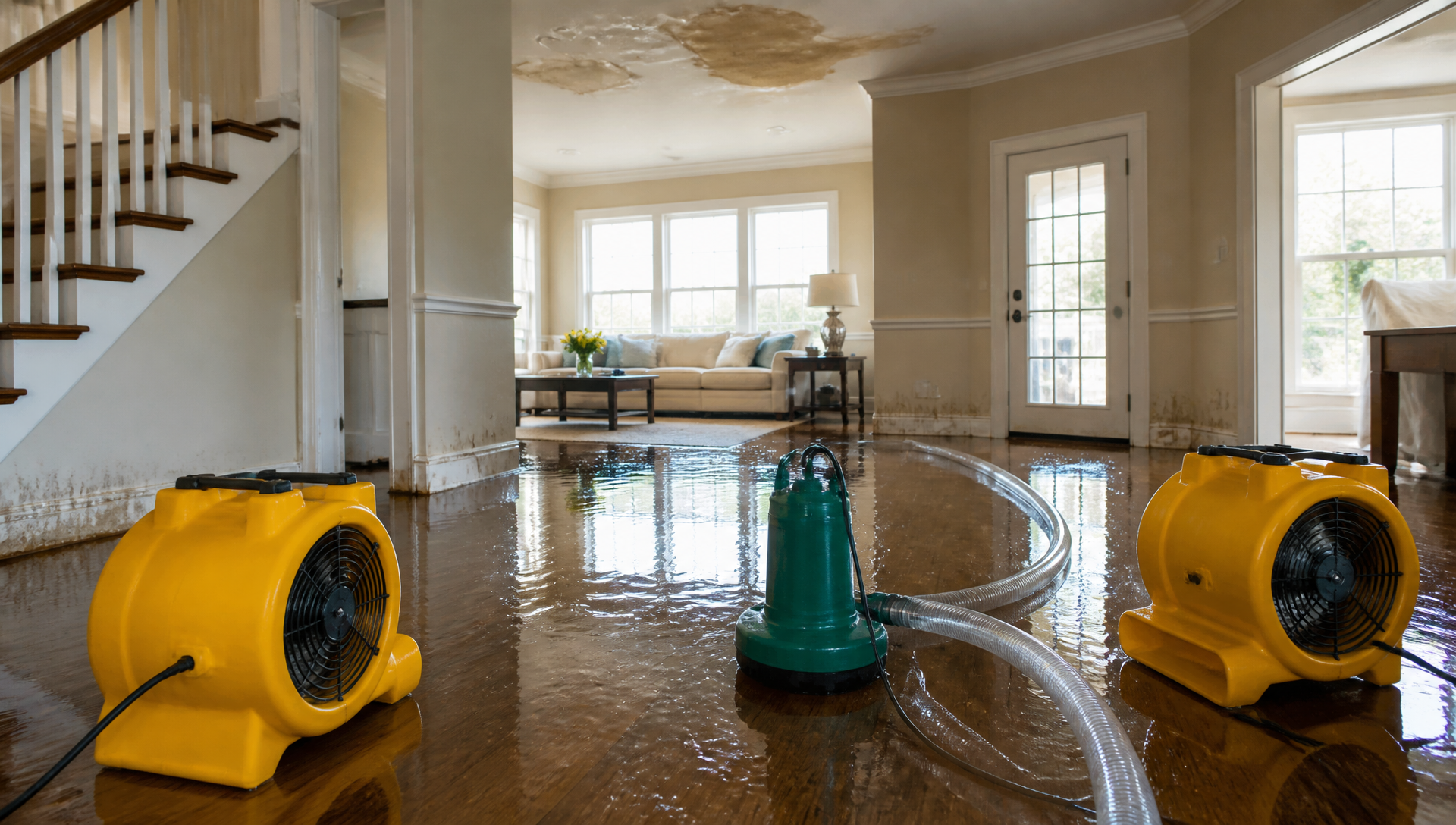
Restoration drying is not fans pointed at a wet floor. Each piece of equipment does one job:
- Truck-mounted and submersible extractors remove bulk standing water. Every gallon extracted mechanically is a gallon that does not have to be evaporated, which is why extraction is always maximized before drying begins.
- Air movers are directed across wet surfaces at a shallow angle to break the saturated boundary layer of air sitting on the material, which is what allows evaporation to continue.
- LGR (low grain refrigerant) dehumidifiers pull the evaporated moisture out of the air. Standard dehumidifiers stall at moderate humidity; LGR units keep removing water at low humidity levels, which is what makes a structure reach a dry standard rather than just "less wet".
- Desiccant dehumidifiers are used for Class 4 and large commercial jobs, where even lower humidity is needed to pull bound water out of dense material.
- HEPA air scrubbers and negative air machines filter airborne particulate and spores, and keep contaminated air from migrating to clean parts of the building.
- Moisture meters, thermo-hygrometers and thermal imaging are the measurement side. Thermal imaging finds where water travelled; meters quantify how wet the material is; hygrometers confirm the drying environment is actually working.
How dryness is verified
A structure is dry when moisture content in the affected material matches a dry standard taken from the same type of unaffected material in the same building. That is the whole test, and it is why documented readings matter more than any promise about turnaround time.
A properly run job produces a daily log: outside conditions, conditions inside the drying chamber, and moisture content readings at marked points in the affected material. Readings should trend down every day. A flat line for two consecutive days means the drying plan is not working and the equipment configuration needs to change, not that the job is done.
This documentation is also what an insurance carrier needs. A claim supported by daily moisture logs and photographs is a claim that gets paid without argument. If a contractor cannot show you moisture readings, they cannot show your carrier either. More on the claim itself in our insurance claims guide.
The process, step by step
- Emergency response and safety. Stop the water source, kill power to affected circuits, identify hazards.
- Inspection and moisture mapping. Establish category and class, find the full extent of migration with thermal imaging and meters, set the dry standard, photograph everything.
- Water extraction. Remove all standing and absorbed bulk water.
- Controlled demolition, if required. Remove material that cannot be dried: Category 3 porous material, saturated insulation, delaminated carpet pad, drywall below the water line.
- Structural drying. Place air movers and dehumidifiers to a calculated load, then monitor and reconfigure daily until the dry standard is met.
- Antimicrobial treatment and cleaning. Apply EPA-registered products to affected surfaces; HEPA-vacuum and clean.
- Verification. Final readings documented against the dry standard.
- Reconstruction. Replace what was removed: drywall, flooring, trim, paint.
How much does water damage restoration cost?
Most residential water damage restoration falls between $1,500 and $7,500, with the largest share of jobs landing in the $3,000 to $5,000 range. The spread is wide because four variables drive it:
| Driver | Effect on cost |
|---|---|
| Category | Category 3 requires removal and disposal of material plus containment, and typically runs 2 to 3 times a comparable Category 1 job |
| Class | More affected material means more equipment running for more days |
| Material affected | Hardwood, plaster and stone need specialty drying; carpet over slab is the cheapest case |
| Reconstruction scope | Drying and reconstruction are separate phases; a job needing new drywall, flooring and paint can exceed the mitigation cost |
A small clean-water loss confined to one room, caught the same day, is usually $1,500 to $3,000. A sewage backup across a finished basement with removal and rebuild can reach $15,000 or more.
Does homeowners insurance cover water damage?
Standard homeowners policies cover water damage that is sudden and accidental, and exclude damage from flooding and from gradual leaks. In practice:
| Cause | Typically covered? |
|---|---|
| Burst or frozen pipe | Yes |
| Failed water heater or appliance supply line | Yes |
| Storm damage letting rain in through a damaged roof | Yes |
| Rising surface water or storm surge entering the building | No. Requires separate flood insurance |
| Sewer or drain backup | Only with a sewer backup endorsement |
| Slow leak that caused damage over months | No. Treated as deferred maintenance |
| Resulting mold | Often covered but sub-limited, commonly $5,000 to $10,000 |
Two things protect a claim: documenting the condition before anything is moved or removed, and acting quickly. Policies include a duty to mitigate, so damage that worsened because the homeowner delayed can be denied even when the original cause was covered.
Frequently Asked Questions
Drying alone typically takes 3 to 5 days for a Class 2 loss, longer for Class 3 and 4. Reconstruction adds anywhere from a few days to several weeks depending on what has to be replaced. The drying phase cannot be shortened by adding equipment past the calculated load; material releases moisture at its own rate.
Inside 24 to 48 hours. Mold begins colonizing wet organic material such as drywall paper and wood framing after roughly 24 hours at normal indoor temperatures, and the water category degrades over the same window. Water removed on day one is usually a drying job; water left for several days is usually a demolition job.
For a few square feet of clean water on a hard surface, caught immediately, yes. Beyond that, no, and the reason is measurement rather than horsepower. A household dehumidifier cannot reach the low humidity needed to pull water out of framing and subfloor, and without meters there is no way to know whether material behind the drywall is still wet. Water that looks dry on the surface while the wall cavity stays wet is the most common path to mold.
Insurance treats them as different events. Water damage originates inside the building (a pipe, an appliance, a roof leak) and falls under a homeowners policy. Flood damage is rising surface water from outside the building, which a homeowners policy excludes and only a flood policy covers. The cleanup work overlaps; the coverage does not.
It depends on category and material. Clean water caught early frequently dries in place, hardwood included. Category 3 water means porous material is removed regardless of how little time it sat. The decision is made from moisture readings and category, not from appearance.
The IICRC is the body that writes the S500 standard this page describes and certifies technicians against it. A certified firm is one whose technicians have been trained and tested on the category and class system, drying science and documentation requirements. It is the baseline credential to ask for.
Water in the House? We're Ready 24/7.
30-minute average response across Nassau and Suffolk County.
(516) 306-7749