Water Damage Restoration in Suffolk County, NY
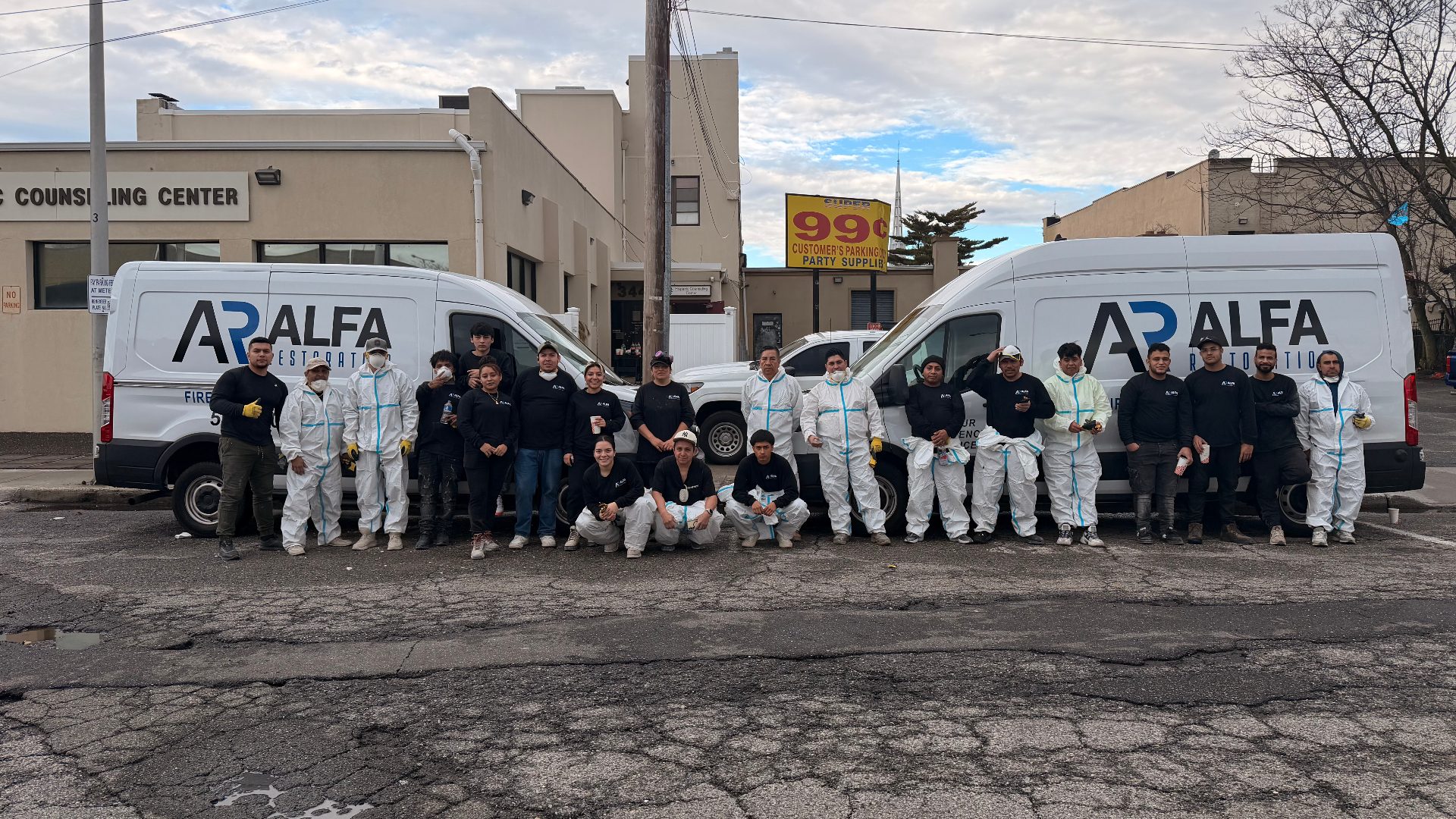
Alfa Restorations is based in Hauppauge, in the middle of Suffolk County, and responds countywide 24 hours a day with a 30-minute average arrival. IICRC-certified crews, industrial extraction and drying, documented moisture verification, and direct insurance billing. From Babylon to Montauk.
We are a Suffolk County company
Our shop is at 66 Cain Dr in Hauppauge, which sits almost exactly at the center of the county. That is not a marketing line, it is a response-time fact: trucks, drying equipment and dehumidifier stock are staged here rather than dispatched from a franchise territory one county over. For most of western and central Suffolk we are inside 30 minutes. For the East End we stage equipment on site rather than making return trips, which is what keeps a Hamptons or North Fork job on the same drying schedule as a Smithtown one.
Suffolk County is three different water damage problems
The county runs roughly 85 miles east to west and the job changes completely along it.
The South Shore and Great South Bay. Babylon, West Babylon, Lindenhurst, Bay Shore, Islip, East Islip, Sayville, Patchogue, Bellport, Mastic, Shirley. Low, flat terrain with bay and creek exposure. Water arrives from outside: surge pushing up the tributaries, sheet flow with nowhere to drain, and a water table that rises under the slab during sustained rain. Many of these neighborhoods were hit hard by Sandy and a significant number of homes have been raised, which moved the living space up but left HVAC, utilities and ductwork in the exposed lower level. Insurance here turns on cause of loss, because surge and rising water need a flood policy and a burst pipe does not.
The central spine and the North Shore. Huntington, Smithtown, Commack, Hauppauge, Dix Hills, Kings Park, St James, Nesconset, Stony Brook, Setauket, Port Jefferson, Mount Sinai. Hills and moraine on the north side, which means runoff travels downhill and arrives against uphill foundation walls rather than seeping evenly. Older village and harbor-front homes bring stone and rubble foundations and plaster walls, both of which hold bound water and need Class 4 specialty drying rather than a standard three-day dry-out. Further inland, around Commack, Hauppauge and Nesconset, the pattern is different again: a regional water table in sand and gravel subsoil that responds to sustained rather than intense rain, so the basement floods two days after the storm rather than during it.
The East End, the Hamptons and the North Fork. Riverhead, Southold, Mattituck, Greenport, Southampton, Bridgehampton, East Hampton, Sag Harbor, Montauk, Westhampton, Hampton Bays. The defining problem here is not geology, it is occupancy. A large share of East End homes are seasonal or second homes, which means a failure that would be caught in an hour anywhere else runs for weeks. A supply line that lets go in February in an unoccupied Sagaponack house is found in April. By then it is not a water damage job, it is a mold remediation and a rebuild. Seasonal shutdown and winterization failures are a distinct category of loss out here and the most expensive one we see. Add a shallow, sand-based water table that responds within hours of rain, pool and irrigation systems sited close to foundations, and on the North Fork, agricultural land draining toward residential lots.
If you own an East End property you do not occupy year-round, the single highest-value thing you can do is have someone physically check it, or install a monitored low-temperature and water sensor. Almost every catastrophic loss we handle on the East End would have been a routine repair if it had been found in the first week.
Towns we serve in Suffolk County
What we do
- Emergency water extraction, truck-mounted and submersible, 24/7
- Structural drying with LGR dehumidification and documented daily moisture readings
- Specialty drying for hardwood, plaster, stone foundations, slab and crawlspace
- Mold prevention and remediation, EPA-registered antimicrobials and HEPA filtration
- Sewage and Category 3 cleanup with full containment
- Septic-related water damage, which is common across Suffolk where private systems are the norm
- Pack-out, inventory and storage of contents
- Reconstruction: drywall, flooring, trim, paint
- Insurance documentation and direct billing
Septic and private wells: a Suffolk-specific issue
Much of Suffolk County is on private septic rather than municipal sewer, and that changes two things.
First, when the water table rises during sustained rain, a septic field can become saturated and stop accepting flow. The result backs up through the lowest fixture in the house, which is usually a basement floor drain or a basement bathroom. This is Category 3 water regardless of how clean it looks, and porous material in its path comes out rather than being dried.
Second, a saturated field and a flooded basement frequently happen in the same storm from the same cause, so treating the basement without addressing the field means it happens again in the next heavy rain. We will tell you when the problem is drainage rather than restoration, and coordinate with a septic contractor rather than drying the same basement twice.
Frequently Asked Questions
About 30 minutes for western and central Suffolk from our Hauppauge shop. Longer for the East End, though we stage equipment on site for those jobs rather than making return trips, so the drying schedule is unaffected. We dispatch 24 hours a day.
Yes, including Montauk, East Hampton, Southampton, Sag Harbor, Shelter Island, Greenport and Southold. Seasonal and unoccupied properties are a large share of our East End work, and those losses need a different approach because the damage has usually been developing for weeks before anyone sees it.
If the backup came through a floor drain or a basement fixture it is Category 3 water, which means containment, removal of porous material in its path, and antimicrobial treatment rather than drying in place. It also means the underlying cause is often a saturated leach field, which is a drainage problem rather than a restoration one. We will say so if that is what we find.
It is different rather than worse. Suffolk has larger lots, more private septic and wells, a longer coastline on both shores, and the seasonal-occupancy problem on the East End. Nassau is denser and older on average, so interior plumbing failures are more frequent. The East End undetected-loss pattern has no real equivalent in Nassau.
Yes. We document the cause, category and extent of the loss to carrier standards, photograph and moisture-map before anything is removed, and bill insurance directly where coverage applies. On South Shore and East End properties where cause of loss determines which policy responds, that documentation is usually what decides the claim.
Yes, including retail, office, medical, hospitality and multi-family. Commercial drying normally needs desiccant dehumidification and after-hours scheduling, both of which we handle.
Water in the House? We're Ready 24/7.
30-minute average response across Nassau and Suffolk County.
(516) 306-7749