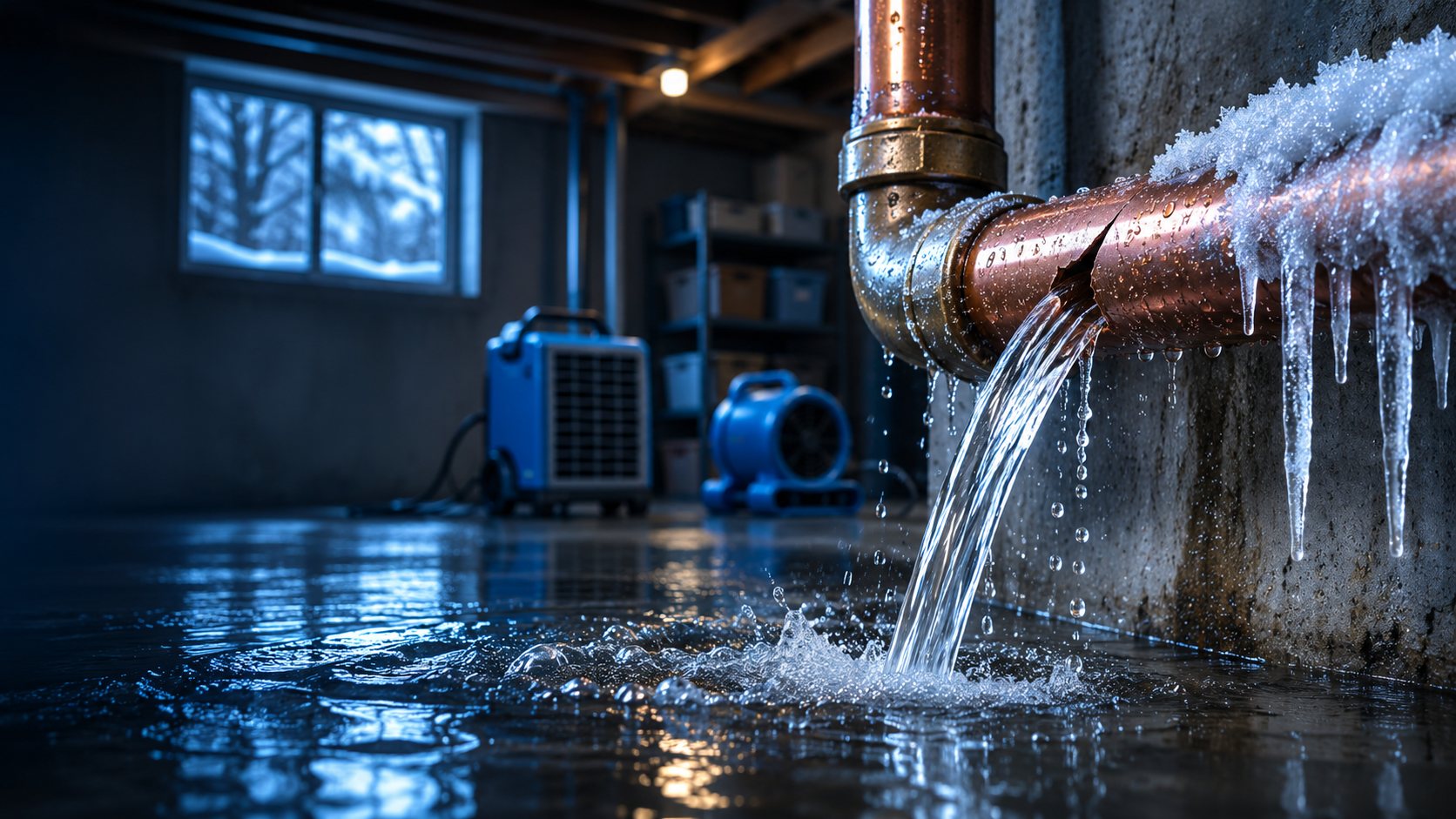
Burst Pipe Repair in Nassau County, NY
A burst pipe can release several hundred gallons an hour, so the water needs to be off and the extraction started the same day. Alfa Restorations responds across Nassau County 24 hours a day with a 30-minute average arrival. IICRC-certified crews, documented structural drying, insurance billed directly.
Why Nassau pipes burst
Nassau's housing stock is the reason. A large share of the county was built between the late 1940s and the early 1960s, in a hurry, to a handful of repeating designs. That produces a very specific failure pattern, and it is why we see the same burst in the same place across thousands of houses.
Original copper is now seventy years old. Copper supply lines have a long life but not an unlimited one, and pinhole failures cluster once the material passes six decades. Nassau's water chemistry does not help: the aquifer supply is slightly acidic and soft, which accelerates pitting from the inside, so a line can look sound and fail from within.
Pipes run through unheated space. Postwar construction here commonly routed supply lines through attached garages, crawlspaces, cantilevered floor sections and exterior wall cavities with no insulation behind them. Those runs sit at or near outdoor temperature on a cold night.
Galvanized steel in the oldest sections. Pre-war housing in the villages still has original galvanized supply lines in places. Those corrode internally, narrow, and then split rather than pinhole.
Owner-added plumbing. Seventy years of extensions, finished basements, added bathrooms and converted garages means a lot of Nassau plumbing was added by someone other than the original builder, often routed along the shortest path rather than the warmest one.
The cold nights that cause it
Pipes do not burst at 32 degrees. They burst when an uninsulated run sits well below freezing for long enough for the water inside to freeze, expand and split the pipe, and then flood when it thaws.
In Nassau that generally means an overnight low in the teens or lower, held for several hours, usually with wind. The North Shore and the barrier beaches are worse than the thermometer suggests, because sustained wind across exposed north and west elevations pulls heat out of wall cavities far faster than still air.
The second pattern is the thaw. A great many bursts are not discovered during the cold snap but on the afternoon it breaks, when the ice plug melts and the split starts releasing water. If you lost water pressure during a freeze and it came back, check for leaks before assuming it was fine.
Where we see them, by area
Central Nassau (Levittown, Hicksville, East Meadow, Westbury, Bethpage, Plainview, Farmingdale): original copper at end of life, slab and crawl construction, garage and attic runs. Mostly single-pipe failures in predictable places.
The North Shore (Great Neck, Manhasset, Port Washington, Roslyn, Glen Cove, Sea Cliff, Oyster Bay, Syosset): larger older homes, more plumbing, more exterior wall runs, and finished lower levels with real value in them. Plaster and hardwood mean Class 4 specialty drying rather than a standard three-day dry-out.
The South Shore and barrier beaches (Long Beach, Island Park, Freeport, Oceanside, Baldwin, Massapequa, Seaford, Wantagh): wind exposure, and on raised post-Sandy homes, supply lines and mechanicals now sitting in an exposed lower level that was never designed to be heated.
The villages (Garden City, Rockville Centre, Mineola, Floral Park, Lynbrook): pre-war housing, original galvanized in places, radiator and steam heating systems that introduce their own failure modes.
Towns we cover in Nassau County
Baldwin · Bellmore · Bethpage · Cedarhurst · East Meadow · Elmont · Farmingdale · Floral Park · Freeport · Garden City · Glen Cove · Great Neck · Hempstead · Hewlett · Hicksville · Inwood · Island Park · Jericho · Lawrence · Levittown · Long Beach · Lynbrook · Malverne · Manhasset · Massapequa · Massapequa Park · Merrick · Mineola · New Hyde Park · Oceanside · Oyster Bay · Plainview · Port Washington · Rockville Centre · Roslyn · Sea Cliff · Seaford · Syosset · Uniondale · Valley Stream · Wantagh · Westbury · Woodbury · Woodmere
Dedicated burst pipe pages for Nassau County:
What we do
- Emergency response and water shut-off, 24/7
- Water extraction and structural drying with documented daily readings
- Specialty drying for hardwood, plaster and slab
- Ceiling and multi-floor water damage from an upstairs burst
- Mold prevention and remediation
- Contents pack-out and storage
- Reconstruction: drywall, flooring, trim, paint
- Insurance documentation and direct billing
Note: we handle the water damage, the drying and the rebuild. The pipe repair itself is a plumber's job, and we will coordinate with yours or recommend one.
How to stop it happening again
The fixes are cheap relative to a claim:
- Insulate the exposed runs. Garage, crawlspace, attic and exterior-wall sections. Pipe sleeve is inexpensive and takes an afternoon.
- Keep the heat on and the thermostat no lower than 55 degrees, including when away. Most policies require it, and it is the single most common reason a burst pipe claim gets denied.
- Open cabinet doors under sinks on exterior walls during a cold snap so room air reaches the pipes.
- Let a tap drip on the most exposed run on the coldest nights. Moving water is much harder to freeze.
- Know where your main shut-off is and check that it actually turns. A seized valve turns a ten-minute problem into a two-hour one.
- If the house will be empty, shut the water off at the main and drain the system, or have someone check it. Add a low-temperature alarm or a water sensor if it is unoccupied for long stretches.
Water in the House? We're Ready 24/7.
30-minute average response across Nassau and Suffolk County.
(516) 306-7749