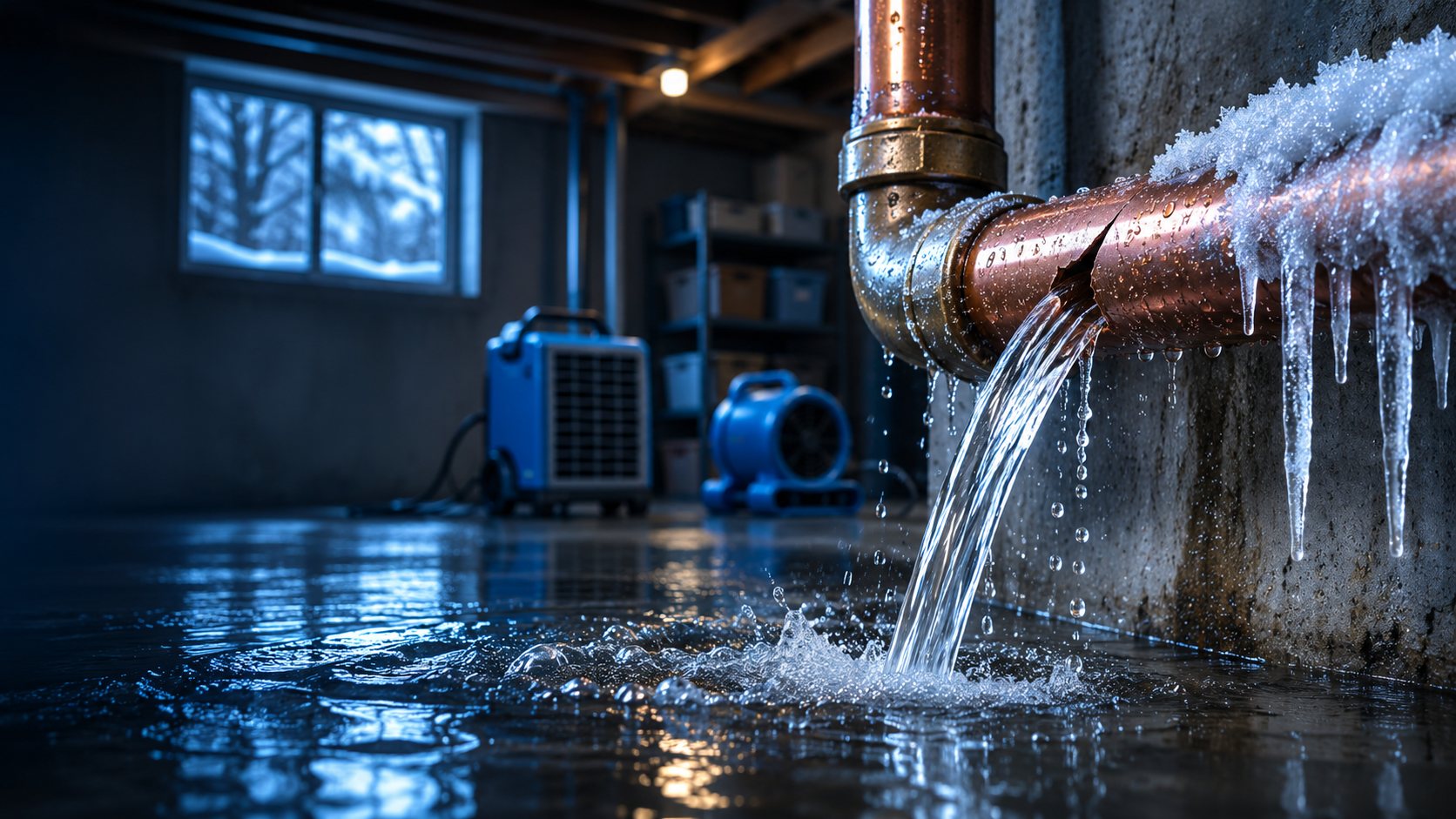
Burst Pipe Repair in Great Neck, NY
A burst pipe can release several hundred gallons an hour, so the water needs to be off and the extraction started the same day. Mold begins colonizing wet drywall and framing after about 24 hours. Alfa Restorations reaches Great Neck in about 30 minutes, 24 hours a day. Call (516) 306-7749.
Why pipes burst in Great Neck
Great Neck is really two different burst pipe problems sharing a name, and which one you have depends on where on the peninsula you live.
Out toward Kings Point and the estate sections, the pattern is exposure and sheer quantity of pipe. Houses on three sides of open water take wind from every direction, and large pre-war and estate-era homes carry far more plumbing than a standard house: multiple bathrooms, service wings, pool houses, guest accommodation and outbuildings, a good deal of it in spaces that are only partially heated or closed down for the winter. Long driveways mean long service runs from the street, and the shallow sections at either end are where they freeze.
Around Great Neck Plaza the problem is completely different. This is one of the densest concentrations of co-op and apartment housing in Nassau, much of it pre-war, and a burst in a multi-unit building is not one household's problem. Water from a failed line on an upper floor travels along joists and arrives in units below and in common areas, often several at once. The responsibility question surfaces immediately, and it gets decided on documentation.
We moisture-map and photograph before anything is removed, specifically so that building management, the board and the insurers are working from the same evidence.
What to do before we arrive
- Shut the water off at the main. It is usually in the basement or crawlspace on the street-facing wall, or in a box near the kerb. Turn it clockwise until it stops.
- Shut off power to the affected area at the panel, if you can reach it without standing in water. If you cannot, leave it and stay out.
- Open a downstairs tap to drain the remaining water in the system rather than leaving it in the pipes.
- If the burst is on a heating line, shut the boiler down too.
- Photograph everything before you move anything. This is what the claim is built on.
- Move what you can lift off the wet floor.
- Do not cut into drywall or ceilings before the inspection.
How we handle a burst pipe
- Dispatch, 30 minutes on average, 24/7.
- Source control and safety. Water off, power isolated.
- Moisture mapping. Thermal imaging and meters find how far the water travelled inside walls, under floors and into ceilings below. This is almost always further than it looks.
- Extraction. Standing and absorbed water out.
- Structural drying, 3 to 5 days, with readings logged daily until they match a dry standard taken from unaffected material in the same house.
- Antimicrobial treatment.
- Reconstruction. Drywall, paint, flooring, trim.
Does insurance cover a burst pipe?
Yes, in almost all cases. A burst pipe is sudden and accidental, which is exactly what a homeowners policy is for, and it is one of the most reliably covered losses there is. The policy normally covers both the water damage and the resulting repairs, though not always the failed pipe itself.
Two things can jeopardize a claim. The first is heat: most policies require you to maintain heat in the property, so a pipe that froze because the heating was off in an unoccupied house can be denied. The second is delay, because policies include a duty to mitigate, so damage that got worse while you waited may not be covered even though the burst itself was.
If the house is vacant or seasonally unoccupied, check the vacancy clause in your policy. Many reduce or exclude coverage after 30 or 60 days unoccupied.
Serving Great Neck and nearby
Common questions from Great Neck homeowners
About 30 minutes on average, any hour. We are based in Hauppauge and run crews across Nassau and Suffolk, so a burst pipe at 3am gets the same response as one at 3pm.
Shut the water off at the main first, so that if it has split, it does not flood when it thaws. Then warm the area gradually with the heating or a hair dryer, never a blowtorch or heat gun, and open the tap it feeds so water can move as it melts. If you cannot find the frozen section or the pipe is in a wall, call a plumber before it thaws rather than after.
Yes. We document the cause and extent, photograph and moisture-map before anything is removed, and bill insurance directly where coverage applies.
It depends on where the failure was and what your building's documents say about unit versus common elements. That is exactly why we document the source and the path of the water before any removal, so the question is answered by evidence rather than by whoever argues hardest.
Keep the heat on at a minimum setting rather than off, drain and shut off anything serving an unheated outbuilding, and put a monitored water and temperature sensor in. Also read your vacancy clause now. Many policies reduce or exclude coverage past 30 or 60 days unoccupied, and that is the most expensive thing people discover too late.
More for Great Neck homeowners
Pipe just burst in Great Neck? Call now.
Water is still moving while you read this. Call (516) 306-7749 and we will be with you in about 30 minutes, any hour of the day or night. We extract, dry and document the loss, and we bill your insurance directly.