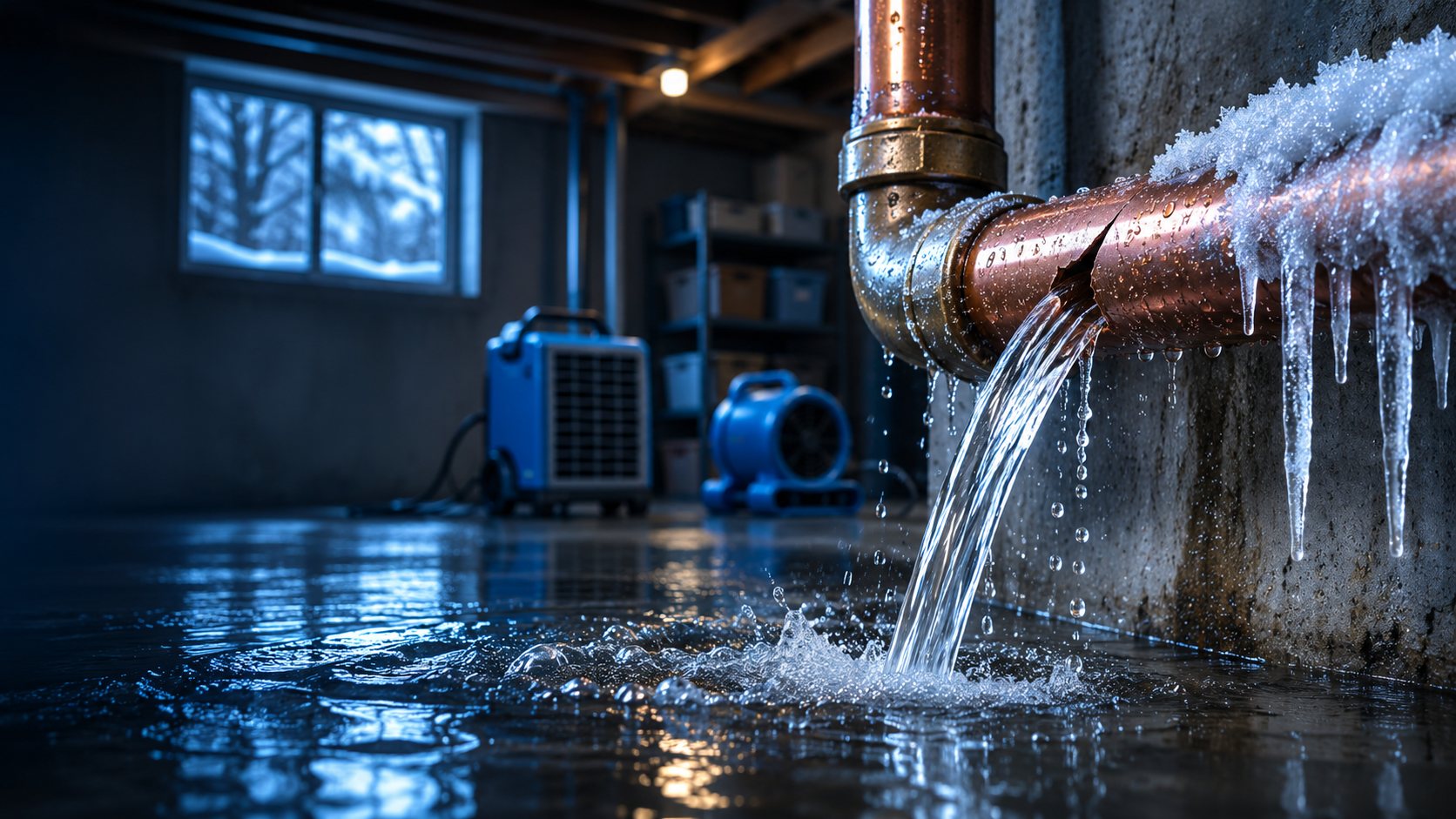
Burst Pipe Repair in Hicksville, NY
A burst pipe can release several hundred gallons an hour, so the water needs to be off and the extraction started the same day. Mold begins colonizing wet drywall and framing after about 24 hours. Alfa Restorations reaches Hicksville in about 30 minutes, 24 hours a day. Call (516) 306-7749.
Why pipes burst in Hicksville
Hicksville is dense postwar housing with original copper now at the end of its life, and the failures cluster accordingly. Built out hard in the 1950s and 60s, the supply lines in a great many of these houses are past the age where pinhole failures start grouping rather than happening in isolation.
Garage and attic runs are the usual location. Construction of this era routinely routed supply lines through attached garages to serve a kitchen or laundry on that side of the house, and through uninsulated attics to serve an upstairs bathroom in houses that were later extended upward. Both spaces sit at close to outdoor temperature on a cold night, and neither gets looked at until something fails.
What separates Hicksville from the hamlets around it is density and conversion. The area around the LIRR station and the Broadway corridor carries a high proportion of two-family and converted housing, and a burst in a converted house is rarely one household's problem. Water from an upstairs failure arrives in the unit below, and the question of who is responsible for which part of the repair comes up immediately. We document the source and the path before anything is removed so that question has an evidence-based answer.
Finished basements are common across the hamlet and raise the cost, turning a straightforward extraction into a removal-and-rebuild decision on drywall, carpet and built-ins.
What to do before we arrive
- Shut the water off at the main. It is usually in the basement or crawlspace on the street-facing wall, or in a box near the kerb. Turn it clockwise until it stops.
- Shut off power to the affected area at the panel, if you can reach it without standing in water. If you cannot, leave it and stay out.
- Open a downstairs tap to drain the remaining water in the system rather than leaving it in the pipes.
- If the burst is on a heating line, shut the boiler down too.
- Photograph everything before you move anything. This is what the claim is built on.
- Move what you can lift off the wet floor.
- Do not cut into drywall or ceilings before the inspection.
How we handle a burst pipe
- Dispatch, 30 minutes on average, 24/7.
- Source control and safety. Water off, power isolated.
- Moisture mapping. Thermal imaging and meters find how far the water travelled inside walls, under floors and into ceilings below. This is almost always further than it looks.
- Extraction. Standing and absorbed water out.
- Structural drying, 3 to 5 days, with readings logged daily until they match a dry standard taken from unaffected material in the same house.
- Antimicrobial treatment.
- Reconstruction. Drywall, paint, flooring, trim.
Does insurance cover a burst pipe?
Yes, in almost all cases. A burst pipe is sudden and accidental, which is exactly what a homeowners policy is for, and it is one of the most reliably covered losses there is. The policy normally covers both the water damage and the resulting repairs, though not always the failed pipe itself.
Two things can jeopardize a claim. The first is heat: most policies require you to maintain heat in the property, so a pipe that froze because the heating was off in an unoccupied house can be denied. The second is delay, because policies include a duty to mitigate, so damage that got worse while you waited may not be covered even though the burst itself was.
If the house is vacant or seasonally unoccupied, check the vacancy clause in your policy. Many reduce or exclude coverage after 30 or 60 days unoccupied.
Serving Hicksville and nearby
Common questions from Hicksville homeowners
About 30 minutes on average, any hour. We are based in Hauppauge and run crews across Nassau and Suffolk, so a burst pipe at 3am gets the same response as one at 3pm.
Shut the water off at the main first, so that if it has split, it does not flood when it thaws. Then warm the area gradually with the heating or a hair dryer, never a blowtorch or heat gun, and open the tap it feeds so water can move as it melts. If you cannot find the frozen section or the pipe is in a wall, call a plumber before it thaws rather than after.
Yes. We document the cause and extent, photograph and moisture-map before anything is removed, and bill insurance directly where coverage applies.
Normally yes. A burst supply line is sudden and accidental, which is the core of what a homeowners policy covers, and an attached garage is part of the dwelling. The two things that can jeopardize it are heat not being maintained and damage that worsened while you waited, so call it in the same day.
The pad almost always does. Carpet itself can sometimes be dried in place if we reach it quickly and the water was clean, but the pad underneath holds water against the slab and is cheap to replace relative to the risk of leaving it. We decide from readings, not from appearance.
More for Hicksville homeowners
Pipe just burst in Hicksville? Call now.
Water is still moving while you read this. Call (516) 306-7749 and we will be with you in about 30 minutes, any hour of the day or night. We extract, dry and document the loss, and we bill your insurance directly.