Sewage Backup Cleanup: What to Do, What Not to Touch, and Why You Should Never DIY This
There's no gentle way to put this. A sewage backup is one of the worst things that can happen inside your home. The water that's coming up through your floor drain or backing up into your basement contains human waste, bacteria, viruses, parasites, and chemicals — and treating it like a normal water cleanup can put your family in the hospital.
If you're dealing with a sewage backup right now, here's exactly what to do and what to avoid. If you're reading this preventatively, save this article. You'll be glad you did.
Get Everyone Out First
Before anything else, get every person and pet out of the affected area. Sewage produces airborne pathogens and gases — including hydrogen sulfide and methane — that can cause respiratory illness, gastrointestinal infections, and in poorly ventilated spaces, can be acutely toxic.
Children, elderly family members, anyone with asthma or a compromised immune system, and pregnant women should leave the home entirely until the area has been professionally cleaned. This is not an overreaction. Sewage exposure is a documented cause of serious illness, and the risk is higher than most homeowners realize.
Shut Off Water and Electricity
If the backup is coming from a fixture connected to your home's plumbing — a toilet that won't stop overflowing, a basement floor drain bubbling up — shut off the main water supply to your house. This stops additional water from entering the system and worsening the backup.
Then shut off the electricity to affected areas at the breaker panel. Sewage water in contact with outlets, appliances, or wiring creates electrocution risk that doesn't go away just because the surface looks calm.
Do Not Try to Clean It Yourself
This is the single most important warning we can give. Homeowners often see standing water and instinctively reach for a mop, a wet vac, or towels. Please don't.
Sewage water is classified as Category 3 black water — the most contaminated category in the restoration industry. It contains E. coli, salmonella, hepatitis A, rotavirus, parasitic worms, and other pathogens at concentrations that can cause serious illness from skin contact, ingestion of microscopic droplets, or inhalation of aerosolized particles.
Standard household cleaning supplies cannot sanitize a sewage-affected area. Bleach, while useful for surface disinfection, doesn't penetrate porous materials where bacteria have already absorbed. Steam cleaners spread contamination through aerosolization. Wet vacs without proper filtration release pathogens back into your home's air.
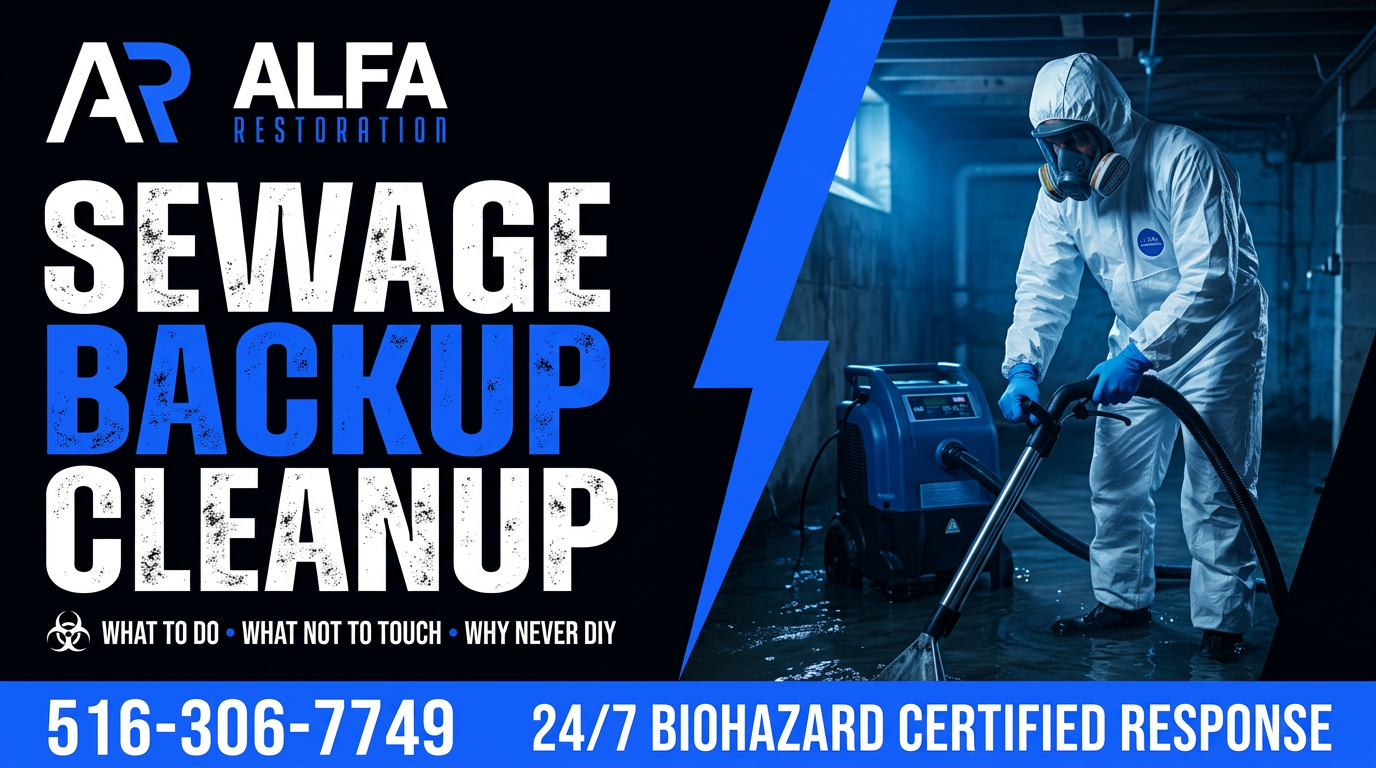
Professional sewage cleanup requires personal protective equipment (typically full-body suits, respirators, and chemical-resistant gloves), HEPA-filtered extraction equipment, EPA-registered disinfectants, and proper disposal protocols for contaminated materials. None of this is available at a hardware store.
What You Can Safely Do Before Help Arrives
Open windows in nearby unaffected areas to ventilate, but do not run your central HVAC system — it will distribute contaminated air throughout the entire house.
Move undamaged belongings out of the room if you can do so without entering the affected water. Wear rubber boots, rubber gloves, and a mask if you absolutely must enter.
Take photos and video for insurance documentation, from a safe distance.
Block off the area from children and pets with whatever you have.
Then call a professional restoration company immediately.
What Has to Be Thrown Away
This is the hardest part for most homeowners. Sewage contamination cannot be safely cleaned from porous materials. That means carpet and carpet padding, upholstered furniture, mattresses, drywall that contacted the water, insulation, particle board, ceiling tiles, and any food items in the area must be removed and disposed of.
Hard, non-porous surfaces like tile, sealed concrete, glass, and metal can usually be disinfected and saved. Hardwood floors are sometimes salvageable depending on how long the contact lasted and how the floor is sealed.
A professional restoration company will catalog everything that has to be removed, document it for your insurance claim, and dispose of contaminated materials according to local hazardous waste regulations.
What's Actually Causing the Backup
Knowing the cause matters because it affects your insurance claim and your prevention strategy.
A clogged main sewer line is the most common cause. Tree roots growing into the line, accumulated grease and debris, or collapsed pipe sections create a blockage that backs up into the lowest fixtures in your home — usually basement drains, ground-floor toilets, or showers.
A municipal sewer overflow happens during heavy rain when the city's sewer system exceeds capacity, and water flows backward into homes. This is increasingly common in older cities with combined storm and sewer systems.
A failed sewage ejector pump in homes with basements below the city sewer line can cause backups when the pump stops working.
The cause matters for insurance. Standard homeowners policies typically exclude sewer backup unless you've added a specific sewer backup endorsement, which usually costs $50 to $250 per year for $5,000 to $20,000 in coverage. If you don't have this endorsement, talk to your agent today — not after a backup happens.
How Alfa Restorations Handles Sewage Cleanup
When you call us for a sewage backup, we arrive in proper PPE, contain the affected area to prevent cross-contamination, extract the contaminated water with sealed equipment, remove and dispose of unsalvageable materials, treat all surfaces with EPA-registered antimicrobials, dry the structure with industrial dehumidifiers, and conduct post-remediation testing to confirm the area is safe before reoccupation.
We work directly with your insurance company, document everything for your claim, and coordinate with plumbers if the underlying cause needs to be repaired. From the moment we arrive, you don't have to think about the cleanup — only about getting your family back into a clean home.
Prevention Worth Doing Today
- Install a backwater valve on your main sewer line if you don't have one. This one-way valve prevents municipal sewer overflows from entering your home and is one of the highest-value preventative investments a homeowner can make.
- Have your sewer line inspected with a camera if your home is older than 30 years, has mature trees near the line, or has had any backup history.
- Add a sewer backup endorsement to your homeowners policy. The cost is small. The coverage gap without it can be devastating.
- Avoid putting grease, wipes (even "flushable" ones), feminine products, or paper towels into your drains.
Call Alfa Restorations 24/7 at (516) 306-7749 for emergency sewage cleanup.