Saving Hardwood Floors After Water Damage — What's Actually Possible
When water reaches hardwood, most homeowners assume the floors are ruined. Sometimes they are. But far more often than people realize, hardwood floors can be saved if the response is fast and the technique is right. The difference between replacement and restoration is usually measured in hours.
Here's what actually determines whether your hardwood survives.
The First 24 Hours Decide Everything
Hardwood is hygroscopic — it actively absorbs moisture from its environment. When water sits on or under a hardwood floor, the wood pulls in water along its grain, expands, and pushes against neighboring boards. This is what causes the cupping (edges higher than center), crowning (center higher than edges), and buckling that homeowners associate with water-damaged floors.
The critical insight is that this process is largely reversible if drying happens fast enough. Wood that has absorbed water for a few hours and is dried properly can return to its original dimensions with minimal lasting damage. Wood that has absorbed water for days has often experienced permanent grain changes, finish damage, and structural compromise that drying alone can't reverse.
This is why we tell homeowners with hardwood floors that response time matters more than for almost any other material.
What "Drying" Actually Means for Hardwood
Surface drying is not enough. By the time water has reached a hardwood floor, some of it has already penetrated through gaps between boards into the subfloor. Drying the top surface while leaving the subfloor wet creates a situation where moisture rises back into the hardwood for weeks, causing damage long after the original event seems resolved.
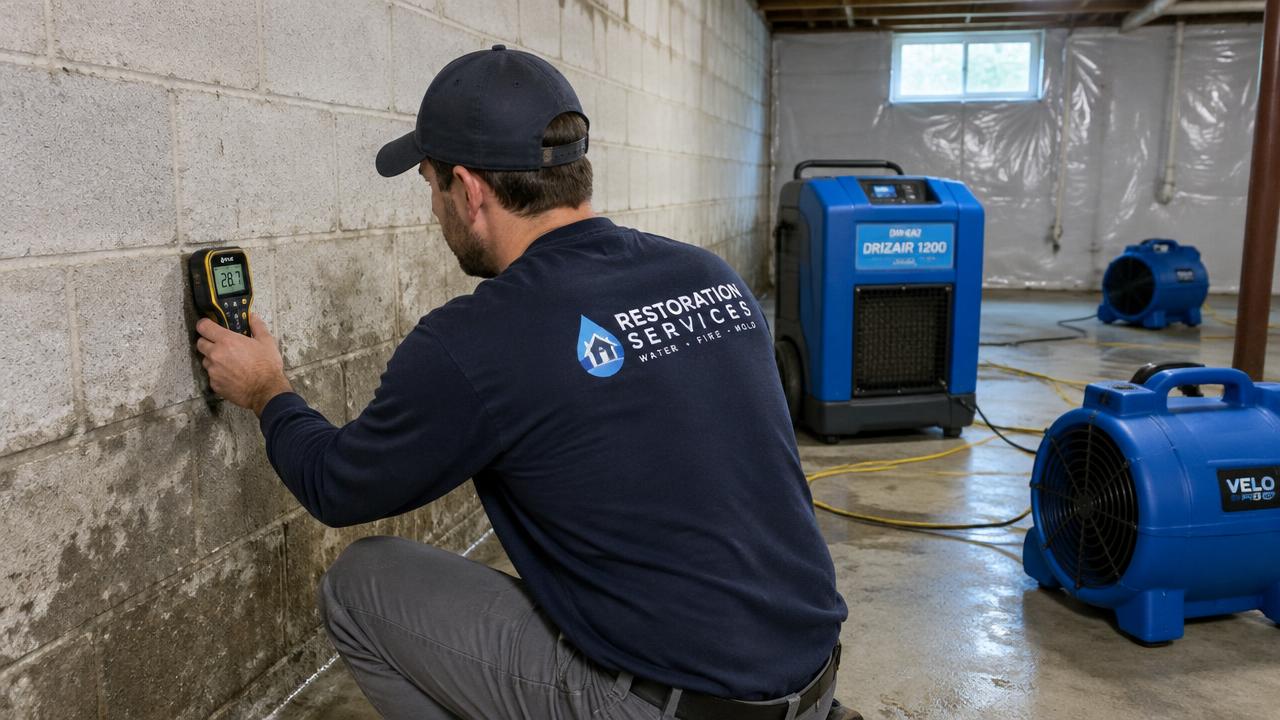
Proper hardwood drying involves industrial dehumidifiers to lower ambient humidity well below normal, high-velocity air movers focused along the floor surface, sometimes specialized floor drying mats that use negative pressure to pull moisture out of the wood from above, and continuous moisture monitoring with meters that read both surface and subfloor moisture content.
The drying target is the wood's pre-incident moisture content, typically 6 to 9 percent depending on your region and the season. Stopping at 12 percent because the floor "looks fine" is how problems return.
Reading the Damage
A few visual indicators help predict whether a floor can be saved.
Light cupping that appeared within the first day is often reversible with proper drying. The wood has absorbed moisture but hasn't yet experienced grain separation or finish failure.
Significant cupping accompanied by gaps between boards suggests the wood has expanded enough to push neighboring boards apart. Drying may bring the cup down, but the gaps often remain and may require board replacement or refinishing.
Crowning — boards higher in the center than the edges — usually indicates the wood was dried unevenly or too aggressively, with the surface drying faster than the bottom. This is a common DIY failure pattern.
Buckling — boards lifting completely off the subfloor — generally means the floor has lost adhesion and structural integrity. Saving buckled hardwood is much harder and sometimes impossible.
Black staining along board edges or in grain lines is a sign of mold or tannin staining caused by prolonged moisture. This often persists even after drying and may require sanding and refinishing or replacement.
When Replacement Becomes Necessary
Some situations almost always require replacement rather than restoration. Water that has been sitting for more than three to five days is generally beyond drying alone. Engineered hardwood (a thin wood veneer over plywood) is much more vulnerable than solid hardwood and often delaminates when wet. Floors that have been flooded by Category 3 black water — sewage or contaminated floodwater — cannot be safely restored because the contamination penetrates the wood.
In these cases, the question becomes what's underneath. If the subfloor is also damaged, the project scope grows significantly, and proper rebuild requires drying or replacing the subfloor before any new flooring goes in.
What the Insurance Side Looks Like
Hardwood replacement costs significantly more than restoration, and insurance carriers know this. Adjusters frequently push for refinishing when replacement is warranted, or for partial replacement when full replacement is the correct call.
A restoration company that documents the floor's pre-damage condition, moisture readings during drying, and final outcomes gives you the evidence to support whatever scope is actually appropriate. Without that documentation, the conversation defaults to what the adjuster wants to authorize.
We've saved many hardwood floors that homeowners assumed were destroyed, and we've also given honest assessments when a floor couldn't be saved. Either way, the answer should be based on measurements, not guesswork.
[CALL ALFA RESTORATION FOR HARDWOOD DRYING ASSESSMENT]
---
Don't wait to find out how much worse it can get. Call Alfa Restorations at (516) 306-7749 — 24/7 emergency response across Long Island.